
What happens when a wallet asks not just for your signature but for permission to show you what that signature will do? For many DeFi power users in the US—traders, liquidity providers, and ops teams juggling multiple chains—the promise of seeing an exact, simulated outcome before confirming a transaction is more than convenience: it is a mitigation against a class of costly, opaque failures known as blind signing. This article examines how Rabby Wallet implements transaction simulation in its Chromium extension, what the mechanism achieves, where it falls short, and how it compares with mainstream alternatives like MetaMask, Trust Wallet, and Coinbase Wallet.
Short answer up front: Rabby’s simulation is a meaningful, mechanistic improvement versus “approve first, ask questions later” UX patterns, but it is not a silver bullet. Its value depends on integration choices (browser extension vs. hardware), the quality of off‑chain analysis, user workflows for approvals, and the limits of what a simulation can infer about on‑chain state at the moment of execution.
How Rabby’s transaction simulation works — mechanism, not marketing
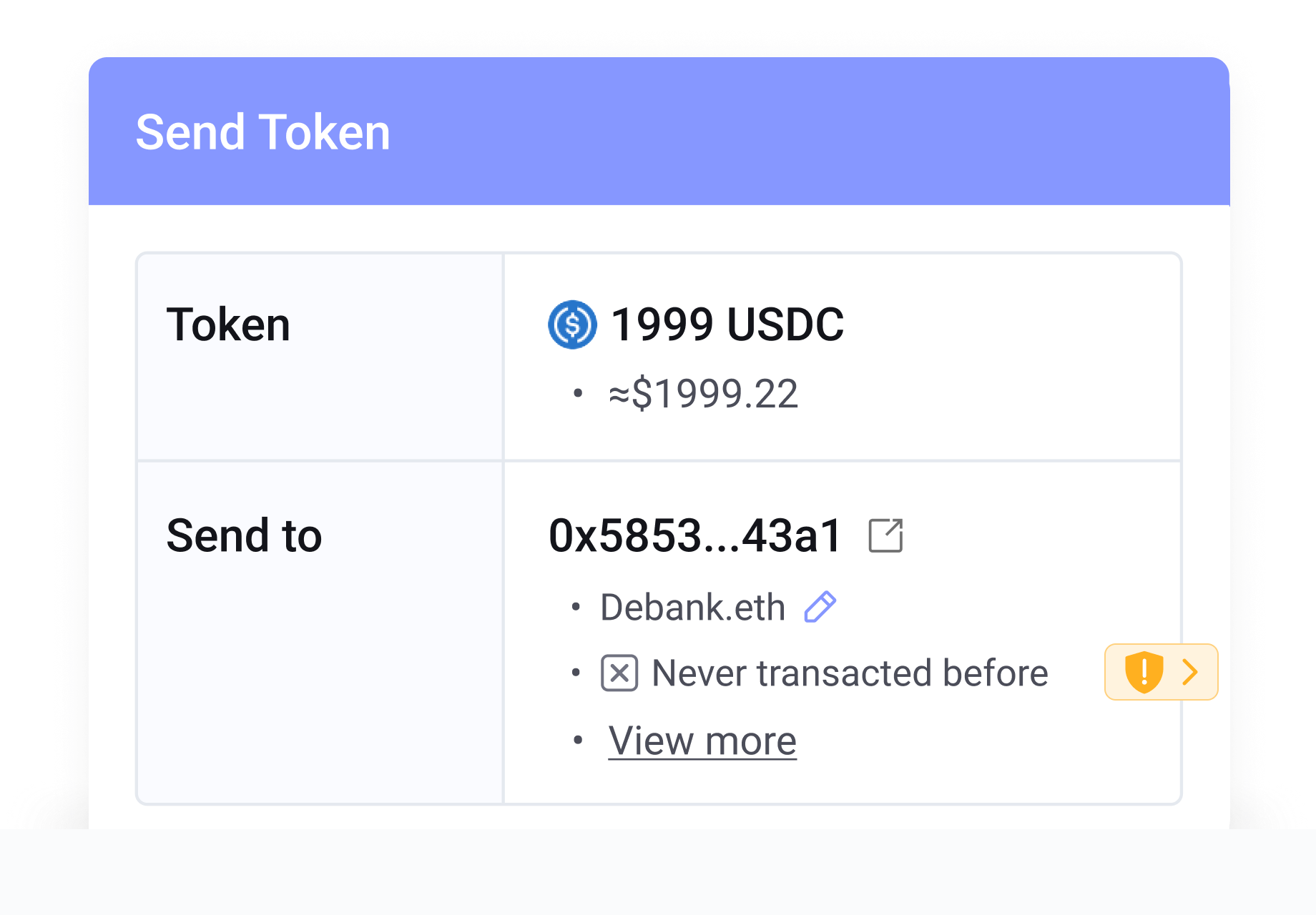
Rabby Wallet, developed by DeBank, integrates a pre‑transaction simulation that runs before the extension prompts for a signature. Mechanically, the extension replays the intended transaction on a local or remote node against the most recent blockchain state it can access, computing expected token balance deltas and estimated gas fees. The result is a readable summary: which tokens move, to whom, and what the fee will cost. This is fundamentally different from a wallet that only displays low‑level calldata or raw spender addresses.
Why does that matter? Because many higher‑risk UX traps in DeFi arise when users grant token allowances or sign complex contract calls without clear visibility into final balance changes. A simulation translates calldata into consequences. For example, a swap or router call that would route funds through several contracts shows the end token amounts; a batch approval shows whether approvals exceed intended amounts. That translation narrows the gap between technical intent and user comprehension.
There are two important sub‑mechanisms: (1) risk scanning and (2) state replay. Rabby pairs its simulation with a pre‑transaction risk engine that flags known compromised contracts, suspicious approval patterns, or nonexistent recipient addresses. The combination—simulation plus risk scan—moves a wallet’s role from passive signer to active filter. But the accuracy of both depends heavily on the freshness and completeness of the node or indexer the extension consults.
What the simulation prevents — and what it cannot
Transaction simulation reduces several real, documented risks. It helps avoid: accidental token approvals that exceed intent, swaps routed through malicious pools, and blind signing of complex router calls. In the best case it reduces human error and the attack surface for phishing dApps that rely on user confusion.
However, simulation has clear limits. First, a simulation is an inference based on a snapshot. Race conditions and front‑running attacks can change the on‑chain outcome between simulation and execution. Second, simulations cannot predict dynamic off‑chain oracles, or private mempool behavior like sandwich attacks; they only report expected outcomes under current state and modeled conditions. Third, a simulation depends on the wallet’s access to reliable indexers and timely data—if the extension queries stale data, the displayed estimate will be misleading.
Another boundary condition: simulations can show that a contract will transfer tokens, but they cannot reliably show intent beyond code behavior—whether the counterparty will later call some admin‑only function, or whether an oracle will be manipulated later. In other words, simulation is a strong guardrail for immediate, transaction‑level clarity, but not a substitute for protocol‑level due diligence.
Trade-offs and design choices: Rabby vs alternatives
Rabby differentiates itself in three architectural choices that matter to power users: (1) robust transaction simulation integrated into the signing flow, (2) built‑in approval revocation, and (3) automatic network switching. Against MetaMask, Trust Wallet, and Coinbase Wallet, these features shift the balance from convenience toward “informed signing.” But trade‑offs exist.
MetaMask remains the dominant default with tremendous dApp compatibility and a vast ecosystem, but it historically emphasized raw calldata and allowances without first showing a human‑readable outcome—though recent versions have added some protections. Rabby’s simulation therefore reduces cognitive load but increases complexity: the extension must maintain accurate parsers for many contract interfaces and route logic for decentralized exchanges. That maintenance burden can create false negatives or parsing bugs.
Hardware wallet users will face another trade‑off. Rabby supports many hardware devices (Ledger, Trezor, Keystone, etc.), but using a hardware wallet plus a browser extension means the simulation lives in the extension layer while the final signing occurs on the device. This is a reasonable split—simulation guides user decisions while the hardware device enforces private key security—but it leaves a small trust surface in the extension’s parsing logic. If a hardware wallet’s UI cannot render the full human‑readable simulation independently, users still rely on the extension’s interpretation.
Operational security and the institutional angle
Institutional and multi‑sig workflows change the calculus. Rabby integrates with enterprise tools like Gnosis Safe, Fireblocks, Amber, and Cobo, which allows teams to combine multi‑party approvals with pre‑signing simulation. For an ops team, the benefit is twofold: simulations can be inserted into approval policies for signers to review, and revocation tools can be included in routine audits. That is a more powerful risk posture than a single‑device wallet alone.
Yet institutions should not treat simulation as compliance proof. A simulation reduces front‑line signing risk but does not replace off‑chain controls: role separation, transaction whitelists, and periodic smart contract audits remain essential. The 2022 Rabby Swap exploit—where a smart contract was compromised for roughly $190,000—illustrates that smart‑contract vulnerabilities and economic exploits can still occur; Rabby’s team froze the contract and compensated users, but the incident shows simulation cannot prevent flaws embedded in third‑party contracts.
Decision framework: when to rely on simulation and when to add layers
For a practical heuristic I recommend three tiers for DeFi power users in the US:
1) Quick, low‑value interactions (small swaps, routine gas top‑ups): rely on simulation plus hardware signing if available; treat simulated outputs as reliable enough once fees and balance deltas match expectations. 2) Medium‑risk activities (large swaps, approvals above a set threshold, adding liquidity): use simulation, enable approval revocation tooling immediately after granting any allowance, and consider splitting approvals to smaller amounts. 3) High‑risk or institutional operations (multi‑million TVL pools, contract upgrades, treasury moves): require multi‑sig signoff, independent contract audits, and staging transactions on testnets; simulation is a helpful but insufficient final check.
One decision‑useful takeaway: always pair Rabby’s simulation with active approval hygiene. The built‑in revocation tool changes the risk equation because once you see an unexpected allowance, you can cancel it immediately—this collapses the time window attackers typically need to exploit approvals.
Practical limitations and what to watch next
Two practical limitations matter for adoption and design thinking. First, Rabby has no built‑in fiat on‑ramp: users in the US must still rely on external exchanges or fiat rails to fund wallets, which adds an on‑ramp friction and centralization point. Second, Rabby lacks native staking within the wallet; if you prefer in‑wallet staking, you’ll use third‑party dApps—where the simulation once again matters but does not remove counterparty risk.
Signals to monitor in the near term include: improvements in mempool modeling to account for front‑running; tighter integration between hardware wallet displays and transaction simulations to remove reliance on extension parsing; and broader adoption of standardized human‑readable transaction descriptors across dApp tooling. Each of these would materially increase the protective value of simulations. Conversely, a decline in on‑chain indexer quality or fragmentation of RPC providers could degrade simulation accuracy, increasing false assurances.
For readers evaluating wallets: if transactional clarity and approval control are primary concerns, Rabby’s browser extension is a strong candidate. If you prioritize maximum ecosystem compatibility with the fewest surprises, MetaMask’s ubiquity still wins. If institutional custody and compliance are paramount, pair Rabby’s simulation with a multi‑sig or custody provider for layered defense.
For a closer look at Rabby’s feature set and installation options, including the Chrome extension and platform support, see the project page for the rabby wallet.
FAQ
Does Rabby’s transaction simulation eliminate the need for audits and smart contract reviews?
No. Simulation provides a snapshot of how a specific transaction would behave against the current blockchain state; it does not prove that the contract is secure or immune to future exploit paths. Audits, code review, and economic analysis remain necessary for protocol‑level security.
How reliable are the simulations when using a hardware wallet?
Simulations guide the decision before the final signature, and Rabby supports many hardware devices. Reliability depends on whether the hardware wallet’s UI can independently confirm the human‑readable outcome. If it cannot, you must trust the extension’s parsing. For highest assurance, use hardware devices that display detailed transaction information and pair them with Rabby’s simulation as a cross‑check.
Can simulation prevent front‑running and sandwich attacks?
Not reliably. Simulation reports expected outcomes given current on‑chain state; it cannot predict adversarial mempool activity or oracle manipulation that occurs between simulation and execution. Other mitigations—slippage limits, private transaction relays, and gas‑strategy controls—are still required.
Is Rabby suitable for institutional workflows?
Yes, when paired with multi‑sig or custody solutions like Gnosis Safe and Fireblocks. Simulation adds reviewability to approvals and transactions, but institutions should layer it with policy automation, off‑chain approvals, and periodic smart contract audits.
